
Part 1: Marketing
[Strategic Planning]
- Storytelling: your offering and how it’s different
- Positioning: your customers and competitors
- Messaging: your content, channels, and connection
Part 2: Projectizing
[Tactical Execution]
Part 3: Operationalizing
[Systematization Engine]
Introduction
I wrote this guide to be useful for anyone who has an offering. Whether you are solo, part of a small team, or a big organization, we all have goals of “selling” our offering to the people around us and our audience at large. I use the word “offering” as an umbrella term for products, services, and brand content.
The basis of this guide is the idea that achieving your goals can be as simple as:
- Planning
- Doing
- Learning
First you plan and set a strategy for achieving your goals, then you roll out and execute the plan, then you incorporate learnings and systematically improve over time. In the context of your offering and the opportunity you have in the market, this Plan-Do-Learn framework maps quite nicely to:
- “Marketing” as the art of planning, strategy, vision, and translation to create differentiation.
- “Projectizing” as the science of doing, execution, mission, and coordination to create momentum.
- “Operationalizing” as the engine of learning, progress, values, and refinement to create evolution.
Think of these as pillars that form the backbone of your go-to-market (GTM) motion. However, they are not set in stone.
They are integrated, cyclical, and continuously serve your brand to maintain uniqueness.
Let’s explore each one.
Part 1. Marketing
Marketing is how you resonate with your audience. Everyone just wants to be entertained, educated, elevated, or have a pain alleviated. How can your offering effectively do this? Part of the equation is getting to know your audience and your position in the market. Represented by your outward looking and strategic 5Cs of Marketing:
- Company: you as a whole, your offering, niche, differentiation, and competitive advantages
- Customers: how, when, and why current and future people will buy from you
- Competitors: strengths and weaknesses of who and what you compete with, including the status quo
- Collaborators: people who support you with a shared interest in the growth of your brand
- Context: the broader macro-environment such as political, economic, social, technological, and regulatory trends
The other part of the equation is your current ability to deliver your offering. Represented by your introspective and tactical 7Ps of Marketing:
- Product: your offering’s value, features, functionality, quality, variety, design, packaging, guarantees, and support services
- Price: monetary details like list price, discounts, bundling, credit terms, margins, and cost-benefit
- Promotion: how you promote and advertise your offering
- Place: where your offering can be purchased, distribution channels, inventory, and logistics
- People: you and anyone else representing your offering, culture, recruitment, and training
- Process: how you meet customer expectations now and your research and development for the future
- Physical evidence: assets, reviews, testimonials, case studies, and social proof
Together they inform your story, position in the market, and serve as a basis for your brand messaging—intended to resonate with your audience across channels.
Let’s illustrate the concepts of storytelling, positioning, and messaging with the following three allegories.
C.O.H.E.S.I.V.E. Storytelling Chutes & Ladders at The Storyteller’s Speakeasy
You slip through an unmarked door in a quiet alley, following the distant hum of a trumpet. The sign outside only said “Open.” Nothing more. Inside, you descend a narrow staircase into a velvet-lit speakeasy filled with smoke, brass, and secrets.
The bartender nods like she’s been expecting you…

“Welcome to The Storyteller’s Speakeasy,” she says, sliding a silver token across the bar. “Here, ladders are earned, chutes are accidental, and every move tells the world exactly who you are.”
She gestures toward a hidden back room where an enchanted board glows under a single chandelier. Tiles twist and shimmer like a living map. Dice float. Cards whisper. Stories linger in the air like perfume.
“You’re here for a ladder,” the bartender says. “Not a chute. So let’s play.”
As you step toward the board, a silky voice curls over your shoulder.
“Before you roll… remember the rule of this place.” You turn to see the Game Master—a sharp suit, gold eyes, smile like a secret.
“No one climbs without a cohesive story. This board feeds on identity. If your story’s clear, aligned, and true, you rise. If it’s messy, confused, or borrowed from someone else—” He flicks a tile. A chute hisses open. “You fall.”
You gulp. He grins. “Shall we begin?”
THE 8 TILES OF THE GAME — C.O.H.E.S.I.V.E.
The Game Master taps the first tile. It glows.

C ↝ Clear, free of jargon, and easy to grasp
“You must declare who you are and what you solve. No smoke. No mirrors. No jargon. Clarity is generosity and your first ladder.”

O ↝ Organized and structured around your value
“If your messaging is scattered or mismatched across channels, you lose momentum like a rigged game.”

H ↝ Human and written in a voice that sounds like you
“Be real. Be vulnerable. Be you. Even in a room full of masks. Connect with your audience on an emotional level with stories of your lessons learned.”

E ↝ Expertise that is backed by substance and results
“Show what you can do. Show how you’ve done it. The game board rewards proof.”

S ↝ Specialized and focused in direction
“The breadth of your experience may get you to the door, but it’s the depth of your specialization that creates trust and gets you the key.”

I ↝ Inspired and revealing the ‘why’ behind your work
“Fuel your story with inspiration. It’s the spark that makes it contagious. Persuade with your passion.”

V ↝ Valued by your audience and focused on outcomes
“Translate your brilliance into their benefit. Make it unmistakable. Make it buyable.”

E ↝ Empathetic and aware of your audience’s needs
“Know their pain. Speak to it. Solve for it. Empathy is the final ladder. The rest is merely décor.”
The Game Master sweeps an arm across the board. “Master these eight tiles, and ladders appear beneath your feet.
Ignore them…trust me…the fall is fast.” He slides the dice toward you. “Now you understand the rules. This isn’t a game of chance. It’s a game of story. Yours…”
Author’s Note
The C.O.H.E.S.I.V.E. acronym is a good checklist to pressure-test your story and any messaging you create around your story for resonance with your audience:
- Clear enough for a stranger to understand?
- Organized across all touchpoints?
- Human and authentic?
- Expertise shown with proof?
- Specialized in a way that’s memorable?
- Inspired with energy and values?
- Valued by translating into impact?
- Empathetic to the audience’s perspective?
If it passes, you’ve crafted messaging that tells your story and sells your value. Remember: great positioning balances heart and clarity. Too much emotion can feel vague; too much precision can feel cold. Finding the language in the middle that is clear and makes sense to your audience is what will move them to act.
When your message aligns with your story, your strategy becomes an extension of your truth.
Creative Positioning Fortune at the Storyteller’s Speakeasy
The Storyteller’s Speakeasy is never in the same place twice. Last time, it was tucked behind a pawn shop on Canal Street. Tonight, you find it beneath a flickering sign that simply reads: FORTUNE.
You step through the door expecting the usual jazz, smoke, and hum of late-night conversation about brand arcs and broken dreams. Instead, the bartender doesn’t pour you a drink—he slides you an obsidian coin, etched with a four-pointed symbol.
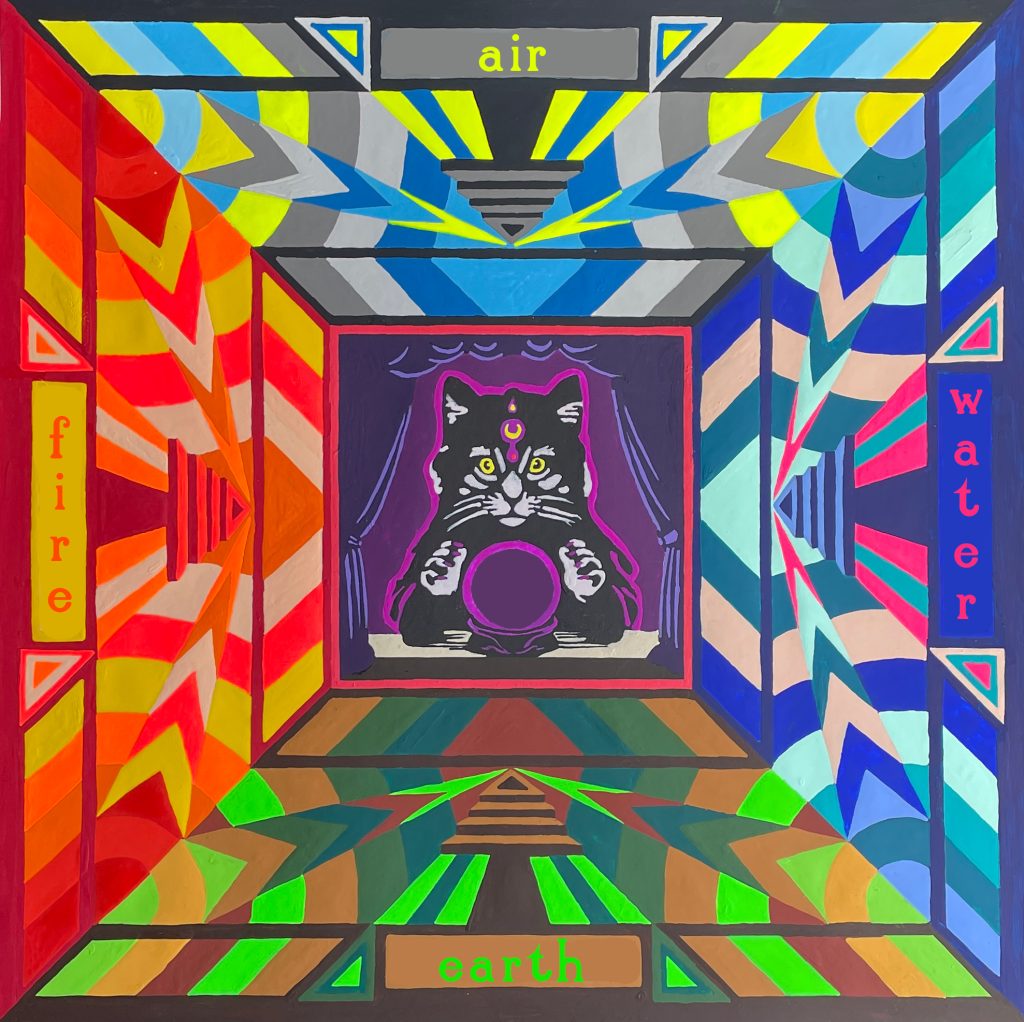
“Back room,” he says. “The Fortune Teller’s in.”
Down a hallway lined with faded show posters and the faint scent of cardamom and ink, you find her—a cat seated in the center of a geometric circle, with four glowing quadrants: earth, fire, air, and water.
Her eyes catch the light like twin moons. “You’re not lost,” she says softly. “You’re just… poorly positioned.”
She taps a tarot card with her paw—its back embossed with the same sigil as your coin. “Four elements. Four truths.
Let’s see what makes your story worth betting on.”
🜃 Earth ↝ Your Journey

The first chamber hums low and steady, the smell of rain on stone. Images flicker in the sand: your first job, your first risk, your first spark of recognition.
The cat’s voice rumbles like a warm purr beneath the surface. “Before you can tell the world who you are, you must remember how you got here. Roots matter.”
She gestures to the ground, where every step you’ve taken becomes a thread in a larger map. “Trace your lineage of work—how your early influences, your mentors, your environments have shaped you. The audience may not see the soil,” she says, “but it’s what makes the garden grow.”
You nod, realizing that clarity begins not with what you do, but with where it came from.
🜂 Fire ↝ Your Specialization

The next chamber flares alive—golden light and heat like a forge. The cat leaps lightly onto a workbench piled with glowing tools.
“Here,” she says, “is where your spark becomes your signature.”
You see moments of intensity: projects where you thrived, skills that felt like second nature, the problems you couldn’t not solve. “This is your North Star,” she continues. “The thing that would burn a hole in the sky if you didn’t do it.”
Flames dance, forming silhouettes of others—coworkers, clients, teams—who benefited from your precision. She smirks. “If you were gone tomorrow, what part of the work would collapse without you?”
You realize that specialization isn’t what you do most, but what you do best when it matters.
🜁 Air ↝ Your Expertise

A door creaks open into a swirl of papers, diagrams, and whispers.
Charts float midair, annotated by invisible hands. The cat strolls across them like stepping stones.
“Fire is passion. Air is proof,” she says. “This is where breadth meets depth.”
Every certificate, every system you’ve mastered, every framework you’ve honed over time—they all orbit around you like constellations of skill.
She flicks her tail toward one. “You’ve built more than experience; you’ve built structure. It’s what lets you scale your brilliance.”
The air hums with clarity.
You breathe it in—methodologies, insights, best practices—all the scaffolding that holds your creative instinct aloft.
🜄 Water ↝ Your Value

Then comes the quiet. The chamber glows blue and soft. Ripples reflect your face a dozen ways, each slightly different.
“This is where your fortune is told,” says the cat. “But not by me—by what flows outward from you.”
She pads to the edge of the reflecting pool. “Your journey and your skill mean nothing if they don’t move people. How does your presence change the current? What feels different when you enter a room, a project, a team?”
You look down. The water shimmers with memories—moments of empathy, collaboration, humor, grace under pressure. The kind of things that don’t fit neatly on a résumé, yet change everything.
“This,” she says, “is your differentiated value. The resonance you create simply by showing up as you.”
The Fortune Unfolds

The four chambers dim, leaving only the cat’s eyes. “You came for a fortune,” she says, voice a whisper and a promise. “But fortunes aren’t foretold—they’re revealed, piece by piece, in the work you dare to own.”
She slides the obsidian coin back across the table. It’s warmer now, pulsing faintly—as if it’s absorbed the heartbeat of every truth you uncovered.
“Keep it,” she says. “It’s your reminder that clarity isn’t a spell—it’s a story. One you keep rewriting every time you step into the world.”
As you turn to leave, you realize the doorway has vanished.
The Speakeasy, the chambers, the cat—all gone.
Only the faint smell of ink and incense remains. And somewhere in the distance, a purr you can’t quite place.
The Ongoing Mystery

Weeks later, in some quiet corner of your day, you find the coin again. The sigil glows faintly when you touch it. For a moment, you hear the cat’s voice—low, amused, knowing.
“Positioning isn’t what you tell the world once,” she murmurs. “It’s how you keep showing the world why you matter.”
You smile. Because the fortune isn’t over. It’s only begun to speak.
Earth — Know your journey.
Fire — Claim your specialization.
Air — Show your expertise.
Water — Reveal your differentiated value.
Together, they form the compass of your story—the elements that turn uncertainty into identity, and identity into opportunity.
Author’s Note
At its core, positioning is context setting for your offering. Without context, offerings can sometimes be very difficult to understand—especially ones that are truly innovative like yours might be! Your audience needs to easily understand your offering, why it’s special, and why it matters to them.
Clue to the Brand Messaging Suite
A creative framework for expressing your brand story, from essence to depth.
Tonight, you join guests at Brand Manor. From the Conservatory to the Study, eight rooms await. Each holds a clue of a different way your story takes shape. Together, these clues form your Messaging Suite: the complete expression of who you are, what you offer, and why it matters.
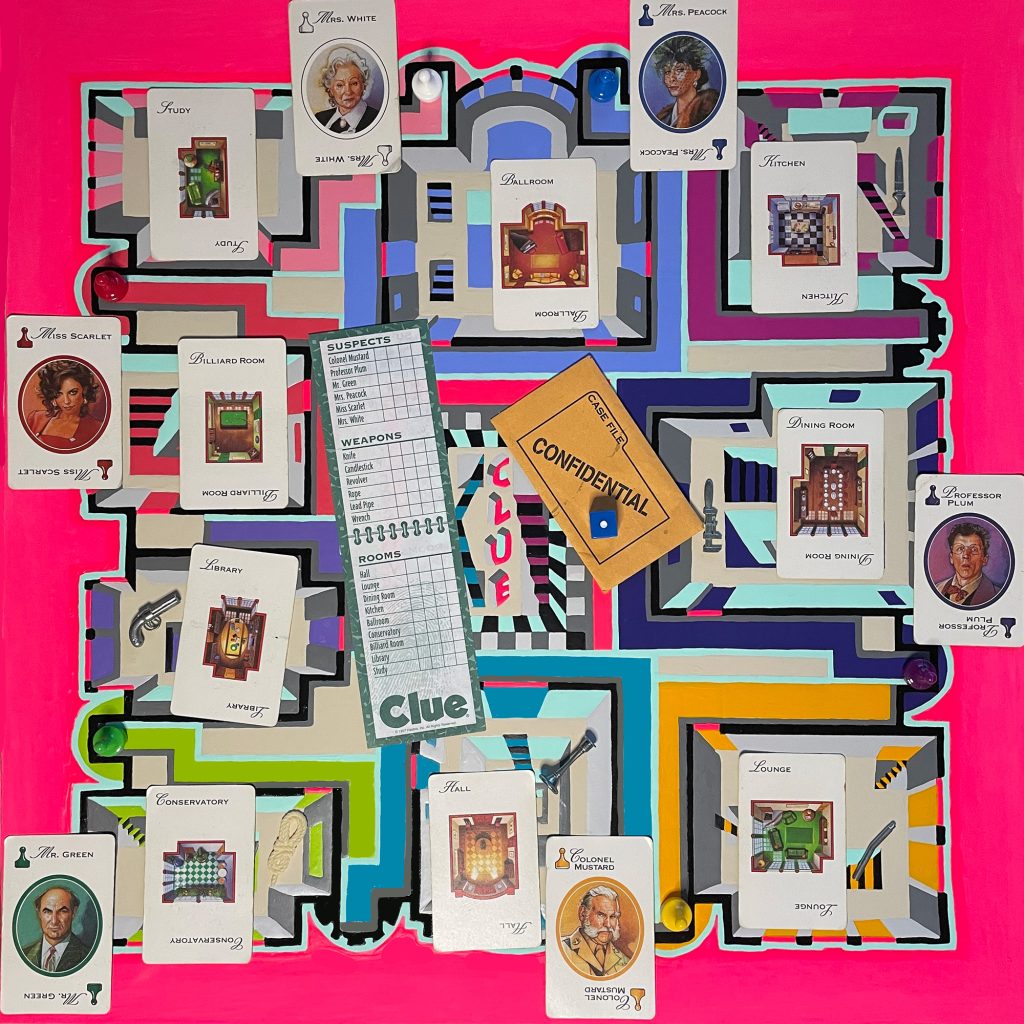

🎩 Let the Game Begin!
From the short, first glance phrases that capture attention to the long-form narratives that build trust and leave a lasting impression. Storytelling, after all, isn’t just about knowing your truth. It’s about communicating it clearly, across every room your brand walks into.
Categories
in the Conservatory
Where stories takes root…

The Conservatory is made of glass. It’s transparent, yet structured. It’s where you place your work within a larger ecosystem: the field, function, or profile that defines your landscape. This is your frame of reference and the category your audience uses to understand you. Before any clue can be solved, we must know the world it lives in.
Taglines
in the Kitchen
Where essence is distilled…

In the Kitchen, something always simmers. This is where ideas reduce down to their simplest, most flavorful form. Enter: your tagline! It’s the enduring line that captures the essence of your identity and purpose. Short, memorable, and repeatable — a scent that stays in the air long after you leave the room.
Headlines
in the Hall
Where first impressions are made…
The Hall is the passage everyone walks through. It’s the first thing people see when they meet your brand. Headlines live here, guiding the eye and inviting curiosity. They announce what’s ahead, grabbing attention with clarity and intent. A great headline opens the door; the rest of the story invites them in.
One-Liners
in the Billiard Room
Where wit meets resonance…

In the Billiard Room, every strike is deliberate. One-liners are crafted with the same precision. They are quick, memorable, and strategic. They summarize what you do and the transformation you create for others, bridging between intrigue and understanding.
Positioning Statements
in the Ballroom
Where you step into the spotlight…
The Ballroom is all elegance and intention. This is where your differentiated value shines in a clear statement of who you serve, how you help, and what sets you apart. It’s your choreography of clarity: the framework that grounds every other message you create. Without it, the dance falls apart. With it, everything flows.
Elevator Pitches
in the Dining Room
Where conversation deepens…

The Dining Room is the heart of connection. This is where stories are shared and meaning unfolds. Your one-paragraph elevator pitch belongs here. It’s the natural, confident way you introduce yourself, what you do, for whom, and why it matters. It’s not a speech; it’s an invitation to join the conversation.
Long Personal Stories
in the Lounge
Where vulnerability and voice meet…

As the evening softens, the Lounge becomes a space of reflection. Here, we explore the long-form personal story: the arc of growth, challenge, and transformation that shapes who you are. It’s the humanity behind the professional, revealing not just what you do, but why you care.
Long Professional Stories
in the Study
Where the narrative resolves…

At last, we arrive in the Study — quiet, grounded, and lined with evidence. Here, the long-form professional story takes shape: your mission, expertise, and value, expanded with proof and philosophy. It’s where every prior clue comes together in a cohesive narrative — the complete expression of your professional self.
THE CLOSING CLUE 🗝
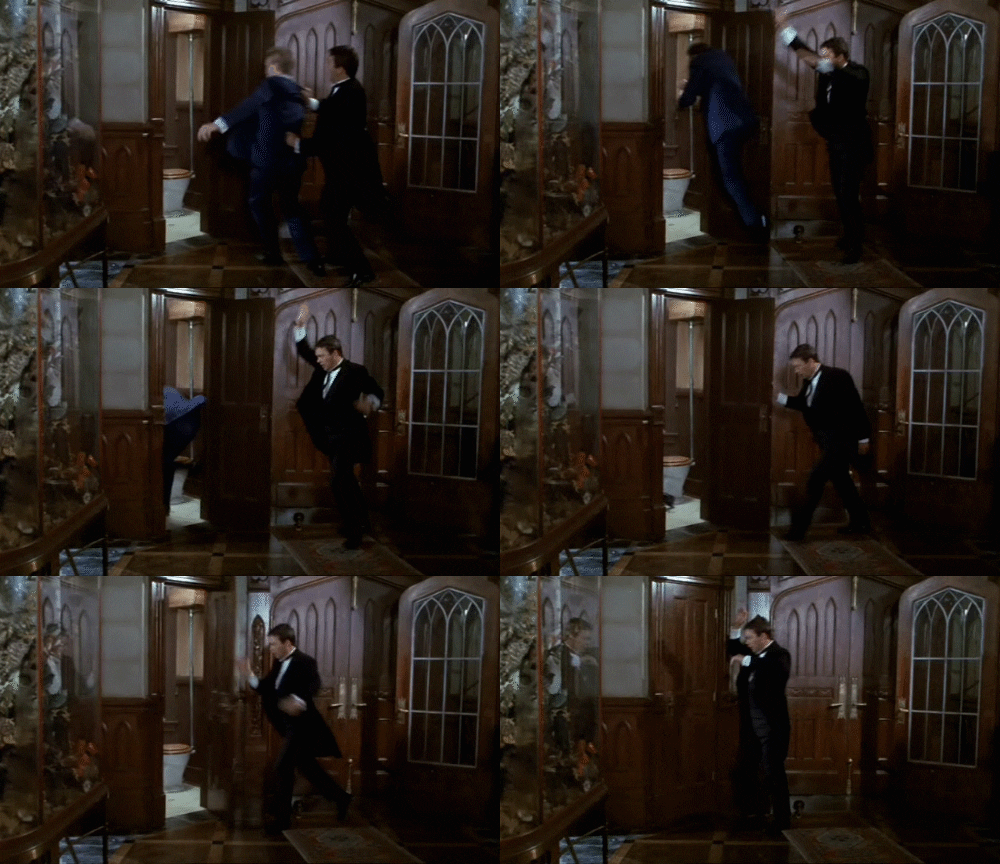
The mystery of messaging is not in hiding who you are but in revealing it, one clue at a time.

Each room holds a truth, each snippet a different way to tell it. Together, they unlock the story only you can tell.
Author’s Note
Your brand can be a long-term, sustainable competitive advantage. Offerings can be copied, but a brand can’t be. A great driver of brand is being a trusted resource on a certain topic. Your channel outreach can be focused on the content that drives your expertise. And how might the snippets in your Messaging Suite be used to guide and support traffic to your content?
Marketing Framed
Tarot Solitaire
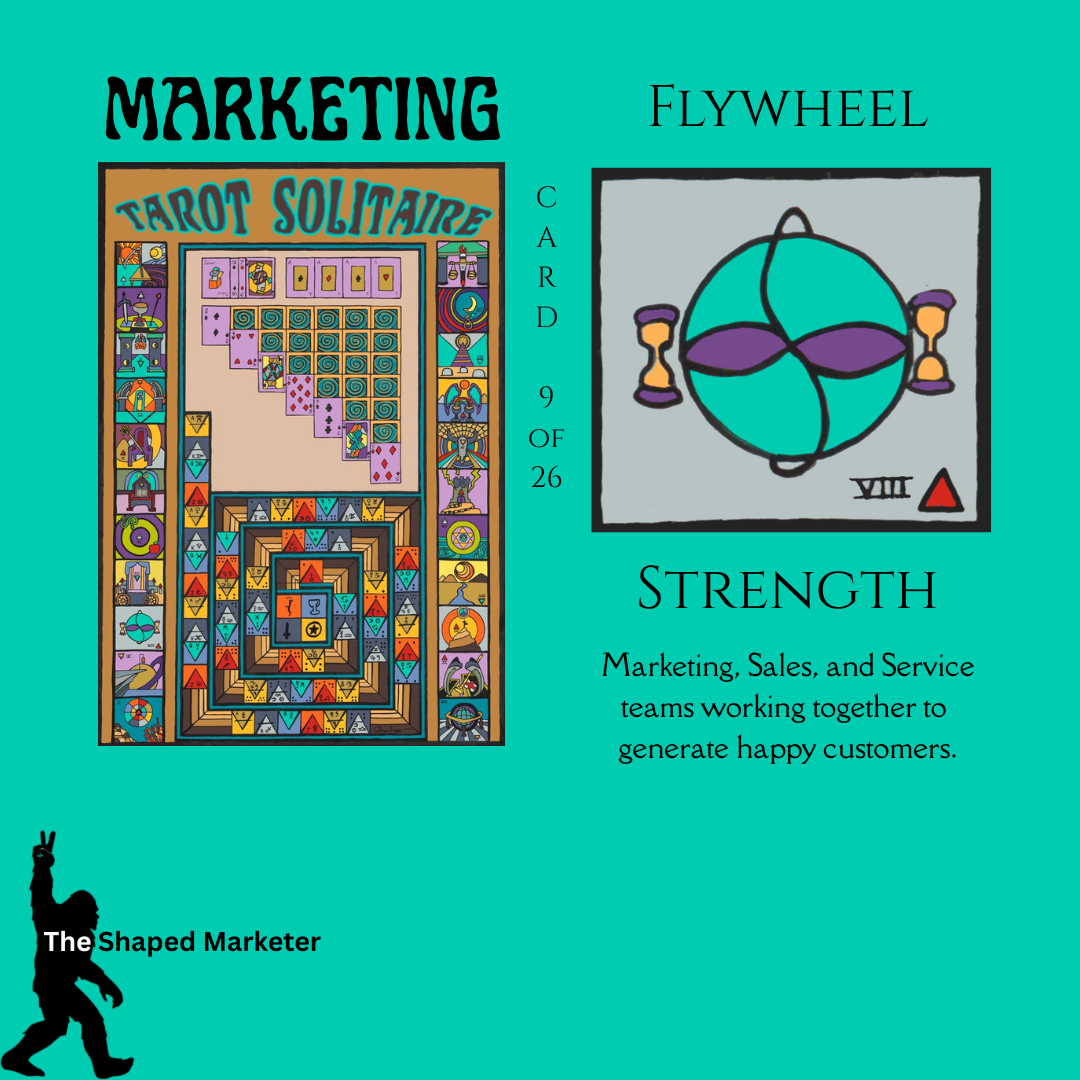
Use the slider to play a deck of Marketing Tarot Solitaire cards and frame your entire go-to-market motion!
Or jump to topics in more detail:
marketing, market, segmentation, research, go-to-market, product-market fit, positioning, funnel, flywheel, mix, goals, strategy, execution, budget, brand, content, copywriting, storytelling, projects & initiatives, project management, agency, technology, automation, AI, analytics, metrics




Part 2. Projectizing
Projectizing is your process to deliver your offering. It takes your goals defined in your Marketing plan and organizes the work (into projects) necessary to achieve them. It’s the execution of your strategy. The foundation of Project Management is the “iron triangle” of scope, schedule, and budget. These are interconnected constraints that need to be managed over the course of any project. Changes to one will inevitably impact the other two:
- Scope: the work that needs to be done
- Schedule: when the work will be done
- Budget: the cost of the work to be done
Scope, schedule, and budget are defined, managed, and kept on track over the course of the five common project phases. These were popularized by the Project Management Institute (PMI) in their flagship publication, the PMBOK® Guide:
- Initiation: where the project’s purpose and goals are defined in alignment with your greater business goals
- Planning: where the project’s scope, schedule, and budget are defined and agreed upon
- Execution: where the project’s work is done to deliver the outcome
- Monitoring/Controlling: where the project’s performance is measured and supported
- Closure: where the project is finally documented, delivered, and reported on
Here’s an allegory to illustrate the concept of Agile Project Management and how the methodology fits nicely with creative work. It’s a system for feedback, collaboration, and growth that protects the human spark behind every deliverable. For creative professionals, it’s a reminder that process doesn’t kill art — it gives it rhythm.
Agile Creative Project
Management Pinball
Creative work is rarely linear. It’s dynamic, reactive, and alive with feedback. Like a pinball machine, an agile creative project is about rhythm, reaction, and flow. You can’t predict every bounce, but you can plan your aim, launch with purpose, and stay present as the ball lights up the field.

When you’re managing creative projects, the goal is less about controlling the chaos and more about designing a system that structures the chaos into creativity. That’s why Agile fits so naturally into creative environments. It gives you just enough structure to support experimentation, iteration, and momentum, without dimming the lights of inspiration.
As an agile creative project manager, you’re juggling five different stages, any of which can be returned to, perhaps several times, over the course of a project. Each pinball machine represents a stage in the project and what you have to keep in play.

Every great project begins with curiosity. This is the discovery phase: understanding what we’re making, who it’s for, and why it matters.
In agile creative management, discovery isn’t just about requirements. It’s facilitating alignment. The team syncs on purpose, goals, and expectations. We define what success looks like and aim our creativity. This is the moment before the plunger pulls back. The spark before the ball launches into play.

Once the purpose is clear, we design the system that supports creativity.
Here, we outline the sprints, map the process, build workflows, and set up collaboration tools. We use creative briefs to transform vision into actionable steps. And we run Agile ceremonies like sprint planning or daily standups that become creative rituals for teams to stay aligned and moving.
Keywords: sprint planning, creative briefs, workflows, collaboration setup.

This is the heart of play where ideas come alive. Design, copy, motion, development, production are all in motion. Agile shines here because it embraces change. Feedback isn’t friction; it’s momentum. Teams iterate quickly, adjust in real time, and keep communication constant.
Agile’s flexibility keeps creativity alive — even under deadline pressure.
Keywords: iteration, creative production, review cycles, adaptive feedback.

After creation comes refinement. This is the stage where creative ops and marketing ops converge: facilitating final edits, version control, channel strategy, and positioning. We prepare assets for launch, tailor them for each platform, and ensure the story lands where it will resonate most.
Agile helps here too, with short cycles of testing and feedback after distribution. We learn what performs and adjust the mix so its always evolving.
Keywords: editing, optimization, channel strategy, QA, deployment.

Finally, we reach expression. The campaign goes live, the product launches, the story meets the world. But in agile, this isn’t “the end.” It’s time for reflection; the retrospective phase. We review performance data and audience feedback to identify what worked and what didn’t.
Every project feeds the next, refining both process and instinct. Agile keeps the loop alive, like a living system that celebrates learning as much as delivery.
Keywords: performance review, analytics, retrospective, continuous improvement.
Project Management
Superhero Monopoly
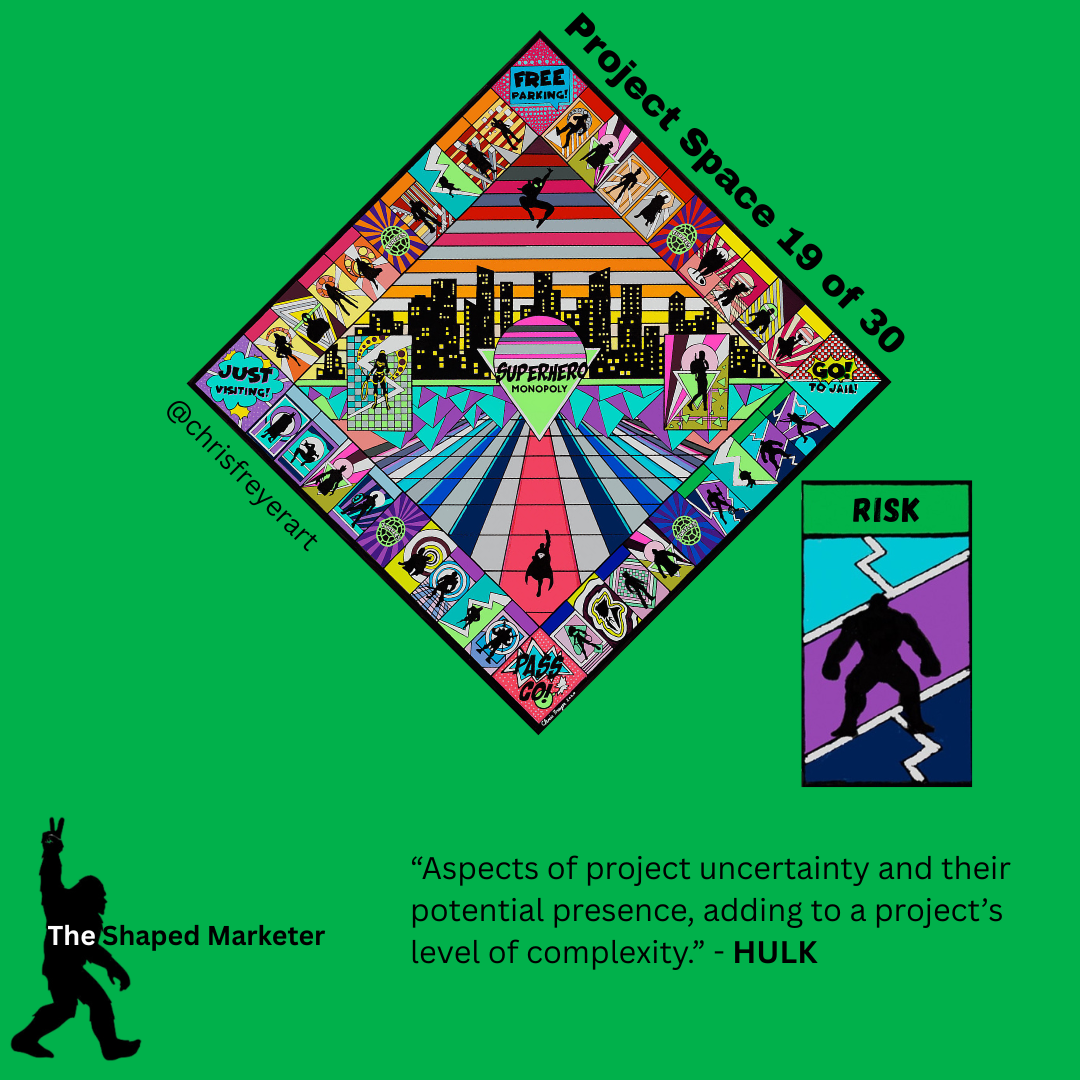
Use the slider to go around the board and monopolize your project management potential!
Or jump to topics in more detail:
projects, lifecycle, management, manager, methodologies, the triangle, stakeholders, deliverable, team, charter, scope, budget, schedule, planning, baselining, milestones, dependencies, resources, risk, procurement, communication, ceremonies, integration, backlog, whiteboard, closure, software tools, office, code of ethics, body of knowledge




Part 3: Operationalizing
Operationalizing is how you improve your offering over time. It’s your process for refining your processes and continually evolving your assets to future-proof your business. It addresses, solves for, and builds culture around:
- Speed: how quickly you’re able to get your current and future offerings to customers
- Pace: the realistic cycle and cadence of feedback necessary to plan and make improvements
- Scale: ways of working better and more efficiently to satisfy increased demand of your offering
Your operations becomes a function of how quickly you can plan (Marketing), do (Projectizing), and learn (Operationalizing). It’s a true orchestration of:
- People: all stakeholders, how they contribute to your offering, and how they are organized into teams and departments. Each person in your organization has a field, function, and role:
• Field: the industry or category of work they specialize in
• Function: the distinct capability or area of work they do for you
• Role: the defined position and responsibilities they have ownership of - Process: the constant refinement of how you work and evaluation of:
• Risk: the mitigation of failures (negative) and the exploration of opportunity (positive)
• Resources: the budget, time, and people allocated to execute the process
• Review – the signals and data coming in from your system - Tooling: the technology you utilize and data being processed by it, working together to help remove friction and automate repetitive tasks:
• Technology tools: the hardware, software, programs, and platforms that collect, store, and analyze data
• Data tools: data warehouses, analytics dashboards, and data quality profilers
Let’s illustrate the concept of orchestrating people, process, and tooling in the following allegories.
Creative Operations
Cranium Carnival
Plan your operations at the weekly carnival!
A very Agile thing to do is divide project work into 1-4 week work cycle “sprints” where you are heavily focused on the task at hand. This allows for a minimum amount of work to be done to get the necessary early feedback to stay the course or decide to pivot from the plan. Each sprint cycle allows you to focus in, get feedback, and then plan the next phase of the project. And so on until the project is done.

Organizing work this way helps you plan out months and quarters. But what about structured days of the work week? Besides having a daily stand up, the day can be structured so people know when it’s time to meet, when it’s time to focus, and when it’s time to launch, review, retrospect, etc.

Mondays
(Marketing)
- planning
- strategy
- vision

Tuesdays
(Project Management)
- coordinate
- execute
- mission

Wednesdays (Operations)
- support
- inform
- focus

Thursdays
(Launch)
- review
- publish
- campaign

Fridays
(Retrospective)
- learn
- improve
- adapt
Author’s Note
Your offering—and the brand you create around it—will not resonate with everyone all the time. And that’s ok. Your Marketing allows you to re-plan, your Project Management allows you to re-do, and your Operations allow you to re-learn, to continuously shape an offering that is meaningful, valuable, and differentiated over time.
It’s likely you’ll find that the more original and unique you are, the more signals you’ll receive of resonance. These signals—and your efforts to continuously improve—is the mutual pursuit of growth that you have with your audience. Grow that brand community! That’s the operation.
Content Conduit
Remote Control
Somewhere in the back corner of a forgotten arcade glows a machine called Remote Control. At first glance, it looks like a relic from another era—VHS tapes, cassette decks, floppy disks, walkmans, cordless phones, blinking buttons beneath neon light. Endless fragments of human communication history. But the machine was never built for nostalgia.

Every joystick sends signals through invisible channels: ads, emails, videos, podcasts, notifications, opinions, posts. The machine hums with transmission between two living systems—the company and the customer—connected through a conduit of content flowing in every direction at once.
The machine never stops broadcasting. Infinite noise and endless transmissions, amplified by algorithms. But every once in awhile, something cuts clean through the static: A story. A message with emotional gravity and resonance. Content so valuable it moves you.
The modern challenge isn’t creating more content. It’s becoming the signal people actually remember. In this age of infinite noise, brands that master meaningful signal are the ones people carry with them long after the screen goes dark.
Author’s Note
Content is the visual expression of your offering. It tells the market what you’re doing, why it matters, what you believe, what you’ve learned, what you’re seeing ahead, and how you’re evolving. So what kind of content are you putting out into the world?
Fibonacci Hopscotch
Court of Opportunity
Noticing an opportunity in the market for your offering? To promote it, hit the Fibonacci Hopscotch court where every hop is a step closer to direct resonance with your audience. You got this!


Make an announcement

Observe responses

Research behaviors

Gather metrics
and data

Compare data
to goals

Decide to stay or pivot

Re-organize
and re-work

Re-distribute

Re-check data to goals

Double down on what’s working
O.P.E.R.A.T.I.O.N. Mindset
The elements needed for successful operation:
- Offering and the long-term vision for it
- Performing and awareness of market trends
- Exploring data and signals to make informed decisions
- Risking positive opportunities within reason
- Adapting and staying agile to pivot when necessary
- Tooling the team to automate and innovate
- Improvising when resources are constrained
- Optimizing what is working to get results
- Nuancing and micro-experimenting to test differentiation
The best operators cycle through these four mindsets and are consistently scoping the entire operation:


Think Big and Plan with Astrology Astronaut
- Where are we headed next?
- What possibilities exist?
- What trends are emerging?
- What signals are appearing?

Focus and Do with Ancient Fundamentals
- What timeless truths still apply?
- What principles should not change?
- What is proven?
- What should be protected?

Experiment and Learn with Creative Magician
- What happens if we try something different?
- What can be combined?
- What can be learned?
- What unexpected opportunity exists?

Double Down and Progress with Straight Shooter Sasquatch
- What’s actually working?
- What’s noise?
- What should we stop doing?
- Where are the results?